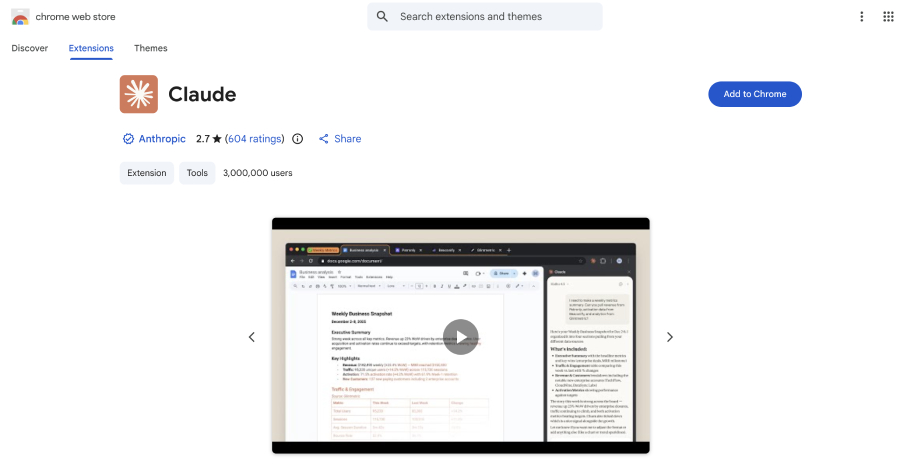
Cybersecurity researchers have disclosed a vulnerability in Anthropic’s Claude Google Chrome Extension that could have been exploited to trigger malicious prompts simply by visiting a web page.
The flaw “allowed any website to silently inject prompts into that assistant as if the user wrote them,” Koi Security researcher Oren Yomtov said in a report shared with The Hacker News. “No clicks, no permission prompts. Just visit a page, and an attacker completely controls your browser.”
The issue chains two underlying flaws –
An overly permissive origin allowlist in the extension that allowed any subdomain matching the pattern (*.claude.ai) to send a prompt to Claude for execution.
A document object model (DOM)-based cross-site scripting (XSS) vulnerability in an Arkose Labs CAPTCHA component hosted on “a-cdn.claude[.]ai.”
Specifically, the XSS vulnerability enables the execution of arbitrary JavaScript code in the context of “a-cdn.claude[.]ai.” A threat actor could leverage this behavior to inject JavaScript that issues a prompt to the Claude extension.
The extension, for its part, allows the prompt to land in Claude’s sidebar as if it’s a legitimate user request simply because it comes from an allow-listed domain.
“The attacker’s page embeds the vulnerable Arkose component in a hidden <iframe>, sends the XSS payload via postMessage, and the injected script fires the prompt to the extension,” Yomtov explained. “The victim sees nothing.”
Successful exploitation of this vulnerability could allow the adversary to steal sensitive data (e.g., access tokens), access conversation history with the AI agent, and even perform actions on behalf of the victim (e.g., sending emails impersonating them, asking for confidential data).
Following responsible disclosure on December 27, 2025, Anthropic deployed a patch to the Chrome extension that enforces a strict origin check requiring an exact match to the domain “claude[.]ai.” Arkose Labs has since fixed the XSS flaw at its end as of February 19, 2026.
“The more capable AI browser assistants become, the more valuable they are as attack targets,” Koi said. “An extension that can navigate your browser, read your credentials, and send emails on your behalf is an autonomous agent. And the security of that agent is only as strong as the weakest origin in its trust boundary.”
📰 Original Source:TheHackerNews ✍️ Author: info@thehackernews.com (The Hacker News)
To provide the best experiences, we use technologies like cookies to store and/or access device information. Consenting to these technologies will allow us to process data such as browsing behavior or unique IDs on this site. Not consenting or withdrawing consent, may adversely affect certain features and functions.
Functional
Always active
The technical storage or access is strictly necessary for the legitimate purpose of enabling the use of a specific service explicitly requested by the subscriber or user, or for the sole purpose of carrying out the transmission of a communication over an electronic communications network.
Preferences
The technical storage or access is necessary for the legitimate purpose of storing preferences that are not requested by the subscriber or user.
Statistics
The technical storage or access that is used exclusively for statistical purposes.The technical storage or access that is used exclusively for anonymous statistical purposes. Without a subpoena, voluntary compliance on the part of your Internet Service Provider, or additional records from a third party, information stored or retrieved for this purpose alone cannot usually be used to identify you.
Marketing
The technical storage or access is required to create user profiles to send advertising, or to track the user on a website or across several websites for similar marketing purposes.