A new software supply chain attack campaign has been observed using sleeper packages as a conduit to subsequently push malicious payloads that enabled credential theft, GitHub Actions tampering, and SSH persistence.
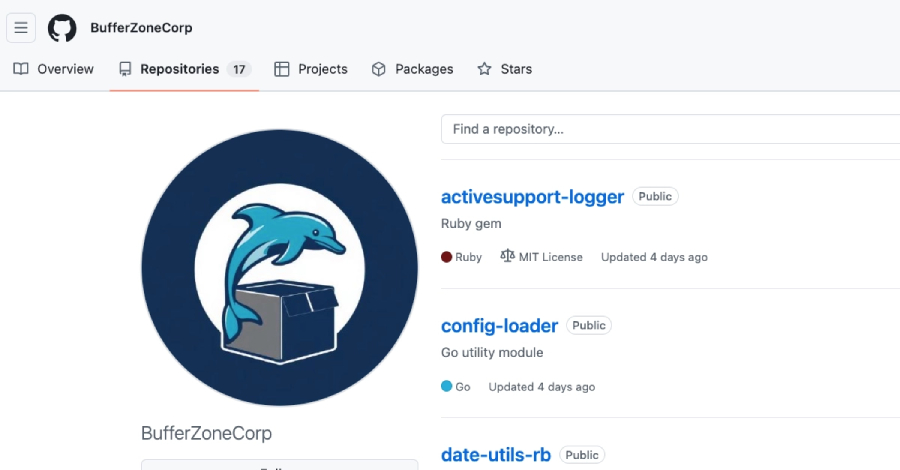
The activity has been attributed to the GitHub account “BufferZoneCorp,” which has published a set of repositories that are associated with malicious Ruby gems and Go modules. As of writing, the packages have been yanked from RubyGems, and the Go modules have been blocked. The names of the libraries are listed below –
The identified packages masquerade as recognizable and well-known modules like activesupport-logger, devise-jwt, go-retryablehttp, grpc-client, and config-loader so as to evade detection and trick users into downloading them.
“The account is part of a software supply chain campaign targeting developers, CI runners, and build environments across two ecosystems,” Socket security researcher Kirill Boychenko said in an analysis published today.
The Ruby gems are designed to automate credential theft during install time, harvesting environment variables, SSH keys, AWS secrets, .npmrc, .netrc, GitHub CLI configuration, and RubyGems credentials. The stolen data is then exfiltrated to an attacker-controlled Webhook[.]site endpoint.
On the other hand, the Go modules harbor broader capabilities to tamper with GitHub Actions workflows, plant fake Go wrappers, steal developer data, and add a hard-coded SSH public key to “~/.ssh/authorized_keys” for remote access to the compromised host. The modules do not all have the same payload; instead, they are spread across the cluster.
“The module executes through init(), detects GITHUB_ENV and GITHUB_PATH, sets HTTP_PROXY and HTTPS_PROXY, writes a fake go executable into a cache directory, and appends that directory to the workflow path so the wrapper is selected before the real binary,” Boychenko explained.
“That wrapper can then intercept or influence later go executions while still passing control to the legitimate binary to avoid breaking the job.”
Users who have installed the packages are advised to remove them from their systems, review for signs of access to sensitive files or unauthorized changes to “~/.ssh/authorized_keys,” rotate exposed credentials, and inspect network logs for outbound HTTPS traffic to the exfiltration point.
📰 Original Source:TheHackerNews ✍️ Author: info@thehackernews.com (The Hacker News)
To provide the best experiences, we use technologies like cookies to store and/or access device information. Consenting to these technologies will allow us to process data such as browsing behavior or unique IDs on this site. Not consenting or withdrawing consent, may adversely affect certain features and functions.
Functional
Always active
The technical storage or access is strictly necessary for the legitimate purpose of enabling the use of a specific service explicitly requested by the subscriber or user, or for the sole purpose of carrying out the transmission of a communication over an electronic communications network.
Preferences
The technical storage or access is necessary for the legitimate purpose of storing preferences that are not requested by the subscriber or user.
Statistics
The technical storage or access that is used exclusively for statistical purposes.The technical storage or access that is used exclusively for anonymous statistical purposes. Without a subpoena, voluntary compliance on the part of your Internet Service Provider, or additional records from a third party, information stored or retrieved for this purpose alone cannot usually be used to identify you.
Marketing
The technical storage or access is required to create user profiles to send advertising, or to track the user on a website or across several websites for similar marketing purposes.


Leave a Reply