A threat actor named Mr_Rot13 has been attributed to the exploitation of a recently disclosed critical cPanel flaw to deploy a backdoor codenamed Filemanager on compromised environments.
The attack exploits CVE-2026-41940, a vulnerability impacting cPanel and WebHost Manager (WHM) that could result in an authentication bypass and allow remote attackers to gain elevated control of the control panel.
According to a new report from QiAnXin XLab, the security defect has been exploited by a number of threat actors shortly after its public disclosure late last month, resulting in malicious behaviors like cryptocurrency mining, ransomware, botnet propagation, and backdoor implantation.
“Monitoring data shows that more than 2,000 attacker source IPs worldwide are currently involved in automated attacks and cybercrime activities targeting this vulnerability,” XLab researchers said. “These IPs are distributed across multiple regions globally, primarily originating from Germany, the United States, Brazil, the Netherlands, and other regions.”
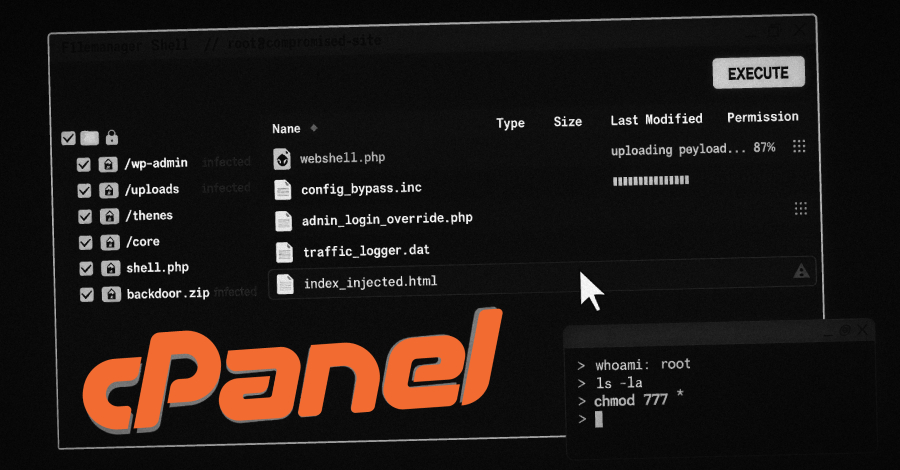
Further analysis of the ongoing exploitation activity has uncovered a shell script that uses wget or curl to download a Go-based infector from a remote server (“cp.dene.[de[.]com”) that’s designed to implant a compromised cPanel system with an SSH public key for persistent access, along with dropping a PHP web shell that facilitates file upload/download and remote command execution.
The web shell is then used to inject JavaScript code to serve a customized login page to steal login credentials and siphon them to an attacker-controlled system that’s encoded using the ROT13 cipher (“wrned[.]com“). Once the details are transmitted, the attack chain culminates with the deployment of a cross-platform backdoor that’s capable of infecting Windows, macOS, and Linux systems.
The infector is also equipped to collect sensitive information from the compromised host, including bash history, SSH data, device information, database passwords, and cPanel virtual aliases (aka valiases), to a 3-member Telegram group created by a user named “0xWR.”
In the infection sequence analyzed by XLab, Filemanager is delivered via a shell script downloaded from the “wpsock[.]com” domain. The backdoor supports file management, remote command execution, and shell functionality.


Leave a Reply