Microsoft’s GitHub repositories have become the latest to fall victim to the ongoing Miasma self-replicating supply chain attack campaign.
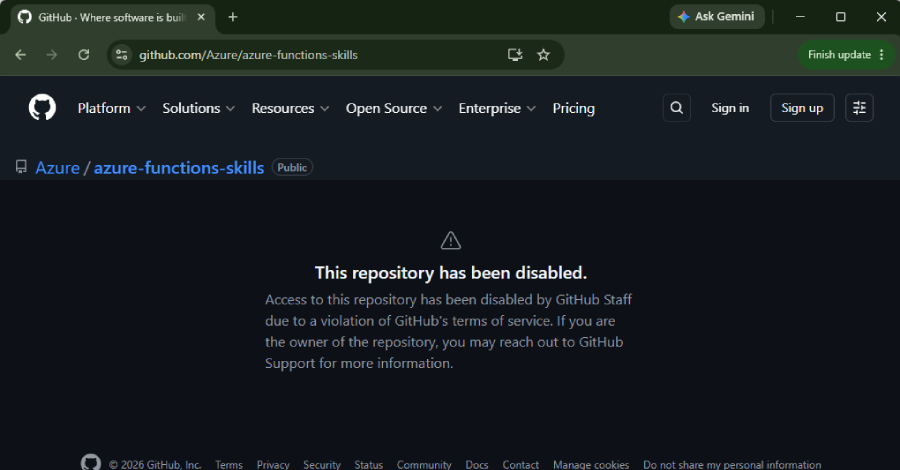
The incident impacted 73 Microsoft repositories across four of its GitHub organizations, including Azure, Azure-Samples, Microsoft, and MicrosoftDocs, per OpenSourceMalware. The development has GitHub to disable access to those repositories.
“Access to this repository has been disabled by GitHub Staff due to a violation of GitHub’s terms of service,” reads the message when attempting to access the “Azure/azure-functions-host” repository. “If you are the owner of the repository, you may reach out to GitHub Support for more information.”
According to OpenSourceMalware, the incident impacts the following repositories –
azure-search-openai-demo-purviewdatasecurity
Connectors-NET-LSP
Connectors-NET-SDK
durabletask
durabletask-dotnet
durabletask-go
durabletask-js
durabletask-mssql
functions-container-action
homebrew-functions
llm-fine-tuning
windows-driver-docs
What’s notable about the latest campaign is the re-compromise of the “durabletask” PyPI package, which was infected by TeamPCP last month to deliver an information stealer on Linux systems.
“A month later, not only is Azure/durabletask gone – so is every sibling repo in the Durable Task ecosystem, sitting one org over in Microsoft: the .NET, Go, Java, JS, MSSQL, Netherite, and protobuf implementations, plus the Durable Functions monitor,” security researcher Paul McCarty (aka 6mile) said.
“When the repo at the root of last month’s compromise is the hub of this month’s takedown, that is not a coincidence – that is the same wound reopening. Whoever held those credentials in May plausibly never fully lost them.”
Miasma is assessed to be a variant of the Mini Shai-Hulud worm that TeamPCP publicly released in mid-May 2026. It has since continued to mutate and refine its tactics, even as it has infected more packages over the past couple of days, using various descriptions of the public repositories containing the stolen secrets –
Miasma: The Spreading Blight
Miasma : The Spreading Blight
Miasma – The Spreading Blight
Hades – The End for the Damned
As of writing, there are 13 repositories with the description “Hades – The End for the Damned” and 82 repositories with the remaining three naming patterns.
Miasma has also been observed skipping the npm registry entirely, with the threat actors pushing malicious code directly to “icflorescu/mantine-datatable” and four related repositories: “mantine-contextmenu,” “next-server-actions-parallel,” “mantine-datatable-v6,” and “mantine-contextmenu-v6.”
“The commit added no dependencies. It planted a 4.3 MB payload runner and wired it to execute automatically through five developer tools: Claude Code, Gemini CLI, Cursor, VS Code, and the npm test script,” SafeDep said. “The attack detonates when a developer clones one of the affected repos and opens it in an AI coding agent. The dropper is the same staged Bun loader, here repurposed for GitHub source-repo persistence rather than registry poisoning.”
These software supply chain attacks have exposed the underlying weaknesses in the trust model that forms the basis of software delivery in open-source ecosystems, making it one of the most significant and sustained campaigns observed to date. What separates the activity from other incidents is its ability to exponentially propagate across the ecosystem by compromising downstream users and repeating the same cycle.
“The worm’s genius and the reason conventional defences largely failed is that it operates entirely within legitimate channels. It does not exploit a vulnerability in npm or GitHub,” FalconFeeds.io said. “It exploits the trust model those platforms are built on: the assumption that if a package is signed with a valid key and published by an authenticated maintainer, it is safe.”
“Shai-Hulud compromises the key and the maintainer, then proceeds to act exactly as a legitimate publisher would. From the registry’s perspective, every malicious publish event is indistinguishable from a routine update.”
📰 Original Source:TheHackerNews ✍️ Author: info@thehackernews.com (The Hacker News)
To provide the best experiences, we use technologies like cookies to store and/or access device information. Consenting to these technologies will allow us to process data such as browsing behavior or unique IDs on this site. Not consenting or withdrawing consent, may adversely affect certain features and functions.
Functional
Always active
The technical storage or access is strictly necessary for the legitimate purpose of enabling the use of a specific service explicitly requested by the subscriber or user, or for the sole purpose of carrying out the transmission of a communication over an electronic communications network.
Preferences
The technical storage or access is necessary for the legitimate purpose of storing preferences that are not requested by the subscriber or user.
Statistics
The technical storage or access that is used exclusively for statistical purposes.The technical storage or access that is used exclusively for anonymous statistical purposes. Without a subpoena, voluntary compliance on the part of your Internet Service Provider, or additional records from a third party, information stored or retrieved for this purpose alone cannot usually be used to identify you.
Marketing
The technical storage or access is required to create user profiles to send advertising, or to track the user on a website or across several websites for similar marketing purposes.



Leave a Reply