
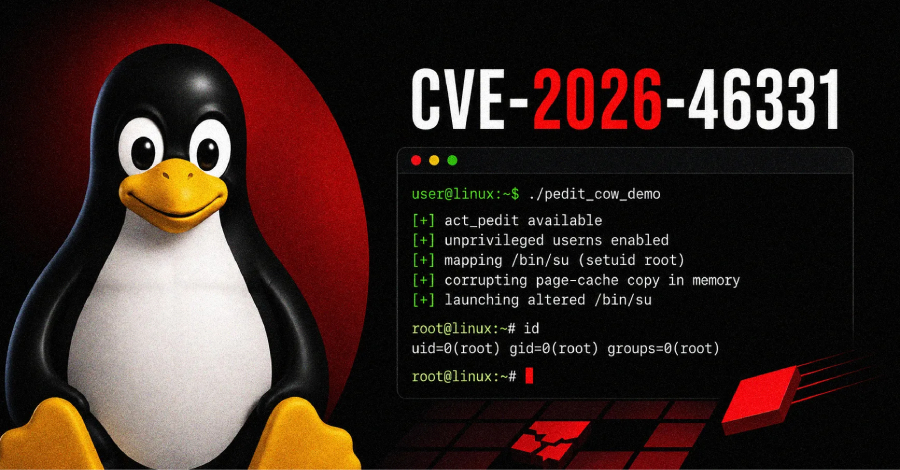

A flaw in the Linux kernel’s traffic-control subsystem can let a local unprivileged user gain root on affected systems.
CVE-2026-46331, nicknamed “pedit COW,” is an out-of-bounds write in the packet-editing action (act_pedit) that corrupts shared page-cache memory. A public, working exploit appeared within a day of the CVE assignment on June 16. Red Hat rates the flaw as important.
The exploit never touches the file on disk. It poisons the cached copy of a setuid root binary (/bin/su) in memory, injects a small payload, and runs that altered image as root. File-integrity checks come back clean while a root shell is already open.
The exploit needs two things: act_pedit being loadable and unprivileged user namespaces being open, giving the attacker a namespace-local networking capability (CAP_NET_ADMIN) needed to trigger the bug.
On the tested RHEL and Debian targets, both conditions were present.
How the Bug Works
Linux’s tc traffic-control tool can rewrite packet headers in flight using an action called pedit. The kernel function that does this, tcf_pedit_act(), is supposed to make a private copy of the data before editing it, the standard copy-on-write pattern.
Leave a Reply