
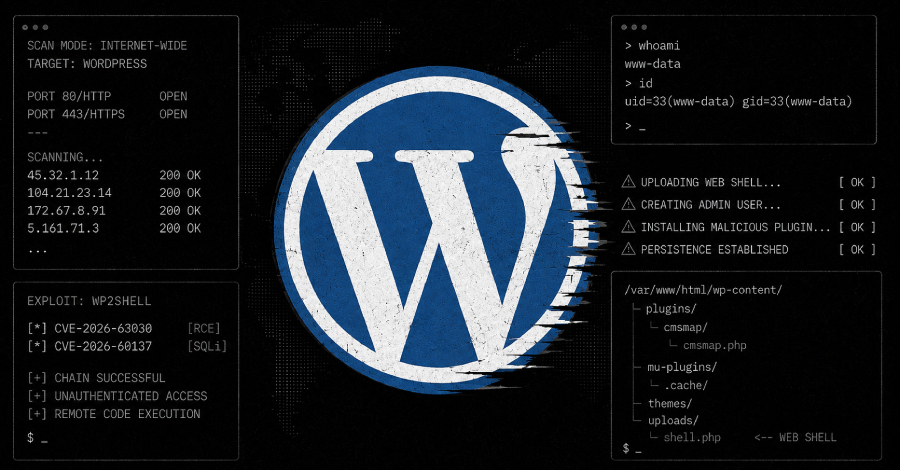

Attackers have begun to exploit two critical vulnerabilities in WordPress that, when combined together, enable unauthenticated remote code execution (RCE) and complete compromise of vulnerable websites.
The two security flaws, tracked as CVE-2026-63030 and CVE-2026-60137, have been codenamed wp2shell.
“By the early hours of Saturday morning (UTC), successful exploitation was already well underway, initially using public exploit code to exfiltrate hashed credentials, with remote code execution following once additional details were made public,” Jake Knott, principal security researcher at watchTowr, told The Hacker News in a statement.
“From our vantage point across a global client base, we are seeing widespread impact of this vulnerability across organizations of every size and every vertical.”
Telemetry data captured by KEVIntel shows that 13 unique IP addresses from Switzerland, Germany, the U.K., Indonesia, Lithuania, the Netherlands, and Singapore have been linked to the exploitation of CVE-2026-63030.
The exploit chain, discovered by Searchlight Cyber using OpenAI GPT 5.6 Sol in over 10 hours, essentially allows unauthenticated attackers to gain remote code execution on default WordPress installations in any WordPress version released since December 2025. Technical details have been withheld in light of the severity of the issue.
Leave a Reply