Cybersecurity researchers have disclosed details of a previously undocumented China-aligned threat cluster known as Bronze Sandcastle that has been observed targeting organizations in Asia and Africa since mid-2025.
“The most distinctive technical marker for Bronze Sandcastle is its consistent use of Sandboxie DLL sideloading,” Sophos security researcher Gabor Szappanos said in a post published Tuesday.
Between August 2025 and August 2026, attacks mounted by the threat actor have resulted in victims in the Philippines, Taiwan, Afghanistan, Namibia, and likely South Korea. Evidence indicates that Bronze Sandcastle is most active in the UTC+8 time zone.
When an application is launched, it needs to load various DLLs in order to function correctly. If the application does not provide the full path to a required DLL, the operating system looks for it in a predetermined sequence of directories.
An attacker can take advantage of this behavior by planting a malicious DLL with the same name as a legitimate one in a location that Windows searches before the folder that contains the actual DLL. Thus, when the legitimate application starts, it proceeds to load and run the malicious DLL, giving the attacker a way in to the system.
“Because the malicious code is executed by a trusted and often digitally signed application, it is less likely to be flagged by antivirus software and other security solutions,” Zscaler noted in an analysis last week.
“If the legitimate application runs with elevated privileges, the malicious DLL will inherit those same permissions, allowing the attacker to perform more sensitive actions on the system.”
What’s more, the technique enables persistence if the compromised application is configured to automatically run every time a system is rebooted, thereby allowing the attacker’s code to execute on the infected host.
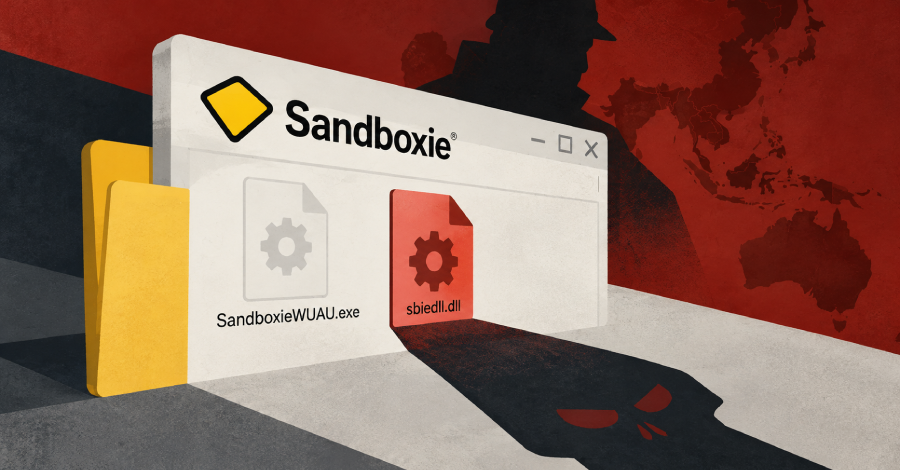
Sophos said it observed legitimate Sandboxie executables placed in multiple victim environments, along with a malicious “sbiedll.dll” file, which, in turn, causes the trusted application (“SandboxieWUAU.exe”) to load attacker-controlled code during runtime.
Besides Sandboxie, Bronze Sandcastle has been leveraged in seven other DLL sideloading combinations –
bginfo64.exe (Sysinternals utility that displays system information) – snmpapi.dll
“The sideloaded DLLs typically read and execute payloads stored in encrypted config.ini files,” Sophos said. “This design minimizes static detection and allows operators to adjust behavior without replacing DLL binaries. Renamed legitimate executables are frequently used to blend into victims’ environments, with execution resulting in in-memory shellcode activity rather than additional disk artifacts.”
The DLL is designed to load and execute an encrypted payload (“config.ini”), which functions as a backdoor designed to enumerate local network and user accounts, as well as collect system metadata, running processes, keystrokes, and screenshots. Two different versions of the payload have been identified to date: 1.1.5 and 1.1.7.
The payload has also been found to communicate with external sites (e.g., file[.]io, gofile[.]io, ably[.]net, and ably[.]io), likely in an attempt to receive additional tasking from its operators. In addition, version 1.1.5 has been observed using dc.cathaypacifice[.]com and net.dpworldto[.]com for command-and-control (C2).
Version 1.1.7 payloads, on the other hand, have been observed communicating with GitHub repositories (“github[.]com/LatonyCharnleyaW”) via the API to download encrypted config files. The GitHub account is no longer accessible.
This is not the first time Chinese hacking groups have relied on DLL sideloading, nor is it the first time Sandboxie has been employed in such attacks. In July 2024, the APT41 threat actor leveraged a different executable signed by Sandboxie (“taskhost.exe”) to sideload a malicious version of “sbiedll.dll” to deploy a backdoor called MoonWalk ultimately.
“The threat group predominantly uses encrypted payload and configuration files that are decoded at runtime, meaning that static file-based detections may be ineffective,” Sophos said. “Organizations should instead focus on behavioral indicators such as DLLs reading local files followed by immediate in-memory execution, which may indicate decoding and staging activity.”
📰 Original Source:TheHackerNews ✍️ Author: info@thehackernews.com (The Hacker News)
To provide the best experiences, we use technologies like cookies to store and/or access device information. Consenting to these technologies will allow us to process data such as browsing behavior or unique IDs on this site. Not consenting or withdrawing consent, may adversely affect certain features and functions.
Functional
Always active
The technical storage or access is strictly necessary for the legitimate purpose of enabling the use of a specific service explicitly requested by the subscriber or user, or for the sole purpose of carrying out the transmission of a communication over an electronic communications network.
Preferences
The technical storage or access is necessary for the legitimate purpose of storing preferences that are not requested by the subscriber or user.
Statistics
The technical storage or access that is used exclusively for statistical purposes.The technical storage or access that is used exclusively for anonymous statistical purposes. Without a subpoena, voluntary compliance on the part of your Internet Service Provider, or additional records from a third party, information stored or retrieved for this purpose alone cannot usually be used to identify you.
Marketing
The technical storage or access is required to create user profiles to send advertising, or to track the user on a website or across several websites for similar marketing purposes.



Leave a Reply