
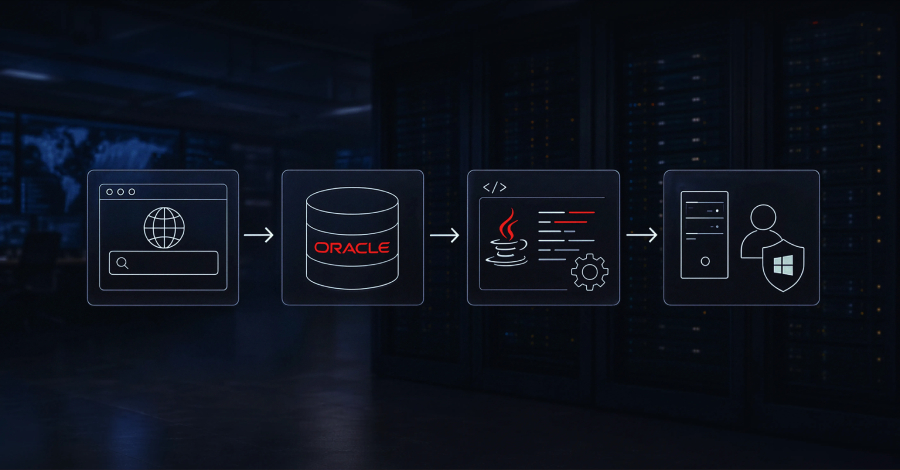

Attackers broke into an organization’s Oracle database through a SQL injection flaw in a public-facing web application, then installed a post-exploitation toolkit without writing an executable to disk. They fed Java source code to the database, let Oracle compile it into stored schema objects, and ran commands from inside the database engine.
Huntress, which tracks the toolkit as khunt, investigated after credential-theft detections fired on July 27, 2026, and traced the chain to SYSTEM-level code execution on the underlying Windows server.
The flaw sat in the application, where an autocomplete search field passed unvalidated input to the database over a Java Database Connectivity (JDBC) connection. The account behind that connection had enough privilege to create Java objects.
No Oracle patch closes either the application flaw or the account privilege behind it. Finding the toolkit means hunting: search the Oracle installation for object names beginning Khunt, and SQL logs for KHUNT%.
A Java class compiled into a database schema object is not a process, a binary, or a file on the filesystem, and endpoint detection and response products do not generally inspect Oracle’s internals. As Huntress frames it, the database stops being something attackers query and becomes a beachhead they attack from.
Leave a Reply