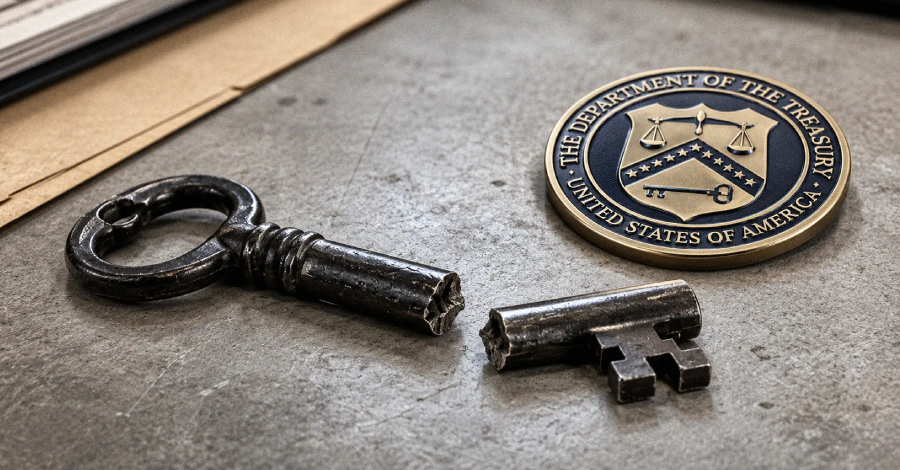
The U.S. Treasury Department’s Office of Foreign Assets Control (OFAC) has designated two individuals and a VPN service provider for enabling ransomware actors’ and other cybercriminals’ malicious activities, including ransomware attacks against Americans.
The VPN, named First VPN Service (1VPNS), has been accused of offering its tools to ransomware groups, along with its 45-year-old Ukrainian administrator, Dmytro Rashevskyi. The department has also sanctioned Yegeniy Vladimirovich Silayev, a Belarusian national, for selling cryptors to help conceal ransomware and other malware as safe programs to avoid being detected by security tools.
First VPN was dismantled in May 2026 as part of a joint law enforcement operation by European and North American authorities for assisting criminal actors to obscure the origins of ransomware attacks, data theft, scanning, and denial-of-service attacks. The service had been operational since 2014, advertising that it neither keeps a log of users’ identities or activities nor cooperates with law enforcement to tackle illegal activity originating from servers it rents to customers.
Per the Treasury, several ransomware groups are said to have purchased First VPN to carry out attacks on U.S. companies and institutions and hide their true origins, deploy malware, and manage exfiltrated data. Victims of ransomware attacks that involved the VPN infrastructure included U.S. businesses, financial services companies, hospitals, and municipal governments.
Ransomware groups using services supplied by the designated parties allegedly caused billions of dollars in losses to American businesses and critical infrastructure providers, U.S. officials said.
“Rashevskyi has used false identities, including ‘Maksim Sorin’ and ‘Roman Chabanenko,’ to buy infrastructure from companies that might otherwise refuse to do business with him because of complaints of abuse from internet service providers about illegal activity originating from 1VPNS servers,” the department said.
The disclosure coincides with the U.K. and E.U. sanctioning Russian cyber networks for their “persistent and increasingly reckless attempts to sow chaos and division across Europe.” The sanctions target 24 individuals and entities behind destructive cyber and hybrid operations, including operators involved in proxy networks linked to the Russian Intelligence Services (RIS).
This includes Russia’s Main Intelligence Directorate (GRU) senior leadership members Vyacheslav Stafeyev, Ivan Senin, and Ivan Kasyanenko for their role in directing GRU cyber and hybrid threat operations. In tandem, Centre 16 of the Federal Security Service (FSB) has been attributed to disruptive sabotage operations against Poland’s energy grid late last year.
“GRU Unit 29155 cyber division worked with cybercriminals, including the company IMPULS, to recruit hackers and cyber specialists from universities and academies across Russia,” the U.K. government said.
The sanctions are also aimed at individuals behind Lumma Stealer for enabling cybercriminals to collect sensitive information from compromised devices at scale. Russia is said to have used the stealer’s stolen credentials to conduct cyber espionage operations against targets globally to support the Kremlin’s objectives.
“Cybercriminals, self-proclaimed hacktivists and private companies linked to Russia, including actors operating under its instructions, direction or control, have also carried out, enabled and facilitated a wide range of malicious activities,” the E.U. said.



Leave a Reply